

PhD student Frankie Butler reflects on navigating fieldwork with a disability, her recent travels to Ireland and Iceland in search of igneous rocks, and how she is working to make earth sciences fieldwork more accessible to all.
My research
I’m Frankie Butler (aka Francesca), a second-year PhD student working with Prof. John Maclennan and Prof. Marie Edmonds in Cambridge, and Prof. Mark Cooper at the Geological Survey of Northern Ireland (GSNI).
Since the age of four, I’ve wanted to be a volcanologist—I even went to a pre-school nativity play dressed in a volcanologist’s asbestos suit made of tinfoil!
My fascination has always been with what happens underneath the volcano. My first ‘field trips’ at age four were spent scurrying up Arthur’s Seat, a volcanic plug in Edinburgh, Scotland, asking: how, where, and why did these awe-inspiring features form?
During school and my undergraduate degree, I was a junior international athlete, representing England and Scotland in field hockey until the age of 20. Unfortunately, a serious accident in 2019 put an end to that, so I now use crutches and a wheelchair full time. This makes fieldwork a challenge, but with careful planning, it’s absolutely doable. I was determined to do a PhD that would take me into the field to study subvolcanic rocks in a geospatial context.
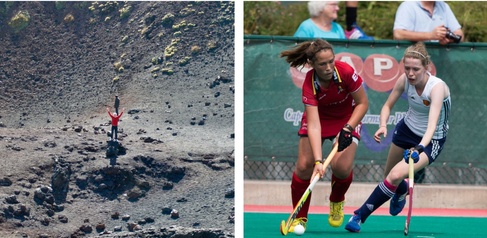
Frankie pictured on left exploring Mt Etna at age 10 (her first adventure to a volcano outside the UK) and, on the right, playing hockey before her injury.
So why travel to Ireland and Iceland to see extinct volcanoes?
My field sites span one end of the North Atlantic Igneous Province to the other—from Slieve Gullion (Sliabh nGullion) on the border between Ireland and Northern Ireland, to Austurhorn in Iceland.
The architecture of sub-volcanic systems can be tricky to study, as they are often complex and deeply buried. Luckily, the landscape of Ireland has been heavily glaciated, revealing a slice through an otherwise hidden magma chamber. The ice has carved away softer sediments and left behind the harder layered igneous rock of a Paleogene 60-million-year-old magma chamber, known as a central complex.
Southeastern Iceland also houses Paleogene volcanic systems. Here, isostatic rebound (where the ground has bounced back as ice sheets retreated) has brought even more rock exposure to the surface, exposing deeper levels of the Icelandic magma chambers than those in Ireland. The tectonic setting of Iceland, a hot spot beneath a spreading ridge, also allows us more access to the volcanic system because there is a thinner lithosphere for the magma to rise through.
Slieve Gullion and Austurhorn are analogues of each other, meaning that they are very similar. We can study these systems side by side to identify commonalities and differences. My interest as an igneous petrologist is in the textures, or patterns, produced by the mixing of silicic and mafic magmas of different composition and viscosity. Both sites have world-class outcrops of these textures and studying them helps us understand how igneous complexes form and the conditions in which their minerals grow.
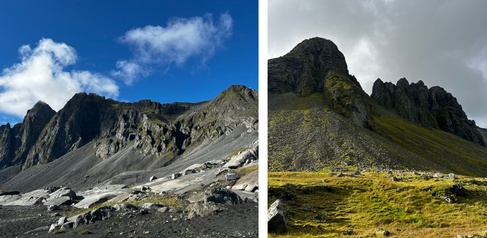
The volcanic scenery of volcanic scenery of Austurhorn and Vesterhorn (austurlands).
So, what does a field day at Slieve Gullion (Sliabh nGullion) look like?
After filling up on a breakfast of porridge oats, we religiously check the weather forecast. This mountain has its own microclimate, and you must be prepared for anything and everything!
Due to my physical disability, planning is extra-essential for any field day. I check the ground conditions (the kind of terrain, including how slippery and steep it is) and plan how long we will be out for. And much more besides…
Luckily, this volcano has a touristic road, built in the 1800s to experience the wonderful views across the central complex and encircling ring dyke—and giving us easy access to the exposure.
Myself and my field assistant, PhD student Jack Beckwith of Trinity College Dublin, plan our sampling sites for the day based on the geology, weather conditions and walking distance from safe roadside parking.
Once at our sample location, I mark it on a GPS and write the coordinates in my geological notebook. I log my oriented observations and take down sketches of important features. Prior to sampling, we record exactly where, within the outcrop, the sample comes from and take photographs.
Then all that’s left to do is take the sample, correctly label it—and into the bag it goes! We repeat this procedure until we’ve collected all the samples for the day.
I always bring a small backpacker’s camping stove, and we sometimes stop for a tea break (very civilised!). This is not always possible, mind, when you have horizontal rain and wind.
At the end of a field day we head to the local pub, listen to some ceol (music), grab a bite to eat, write up our end-of-day thoughts… and away we go to rest ahead of the next day of fieldwork.
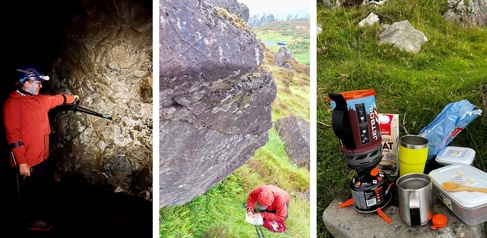
Frankie's fieldwork at Slieve Gullion: exploring a tunnel that cut into the magma chamber (left), making field observations (middle) and stopping for an all-important tea break.
The field adventures continue
More exciting fieldwork lies ahead! I’m heading back to Slieve Gullion and Austurhorn, and I am also beginning research on St Kilda. Watch this space!
Since becoming disabled, accessing fieldwork, the outdoors, and geology as a whole has been challenging. But through persistence, trial and error, and collaboration with universities within the UK and internationally, geoscience is becoming more accessible. Fulfilling fieldwork is increasingly possible with a physical disability.
I use social media to share my experiences as a disabled person studying in the outdoors, and to highlight how we can work together to make the field more inclusive. I’m committed to advancing accessibility in geoscience education and fieldwork, and to encouraging other disabled folk to study the subject I love.
I’m also excited to keep pushing forward in academia—progressing my research on subsurface volcanic systems whilst continuing to teach and spread my passion for earth science, whether I’m wheeling or crutching my way through the field.
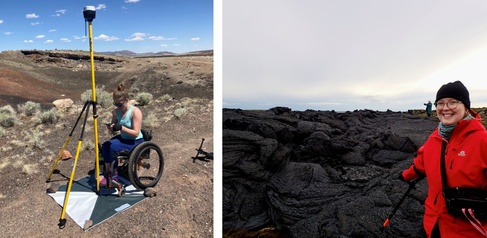
Frankie exporing phreatomagmatic volcanism in arizona on a research trip during my undergraduate degree (left), and on a recent visit to Iceland (right).
Follow Frankie on social media and keep up to date with her adventures here.