

Of all songbirds, the bowerbird has perhaps one of the strangest courtship displays. To attract a mate, males of the species build arched structures or ‘bowers’ using twigs, embellished with colourful objects such as leaves, fruit and even plastic—behaviour famously captured in David Attenborough’s documentaries.
Now, research led by the University of Cambridge, National Museum of New Zealand Te Papa Tongarewa and University of Otago has described a new and unique songbird species that once lived in New Zealand and appears to be from the bowerbird family.
Dated to between 14 and 19 million years old, the researchers think the fossil represents an early member of the bowerbird family, which today is found only in Australia and New Guinea. The ancient bird bears many of the same traits as modern bowerbirds, but was notably more slender and only about half the size of the smallest living species, making it a little larger than a European robin.
"If this bird is indeed a relative of the bowerbirds, it could represent an entirely new songbird family for New Zealand. That’s especially significant given the limited understanding we have of the ancient songbird fossil record in this region,” said Elizabeth Steell, lead author of the study who is based in the Field Palaeobiology Lab at Cambridge’s Department of Earth Sciences.
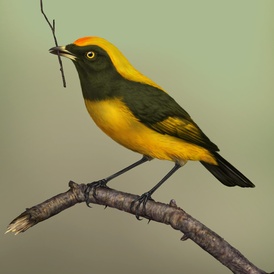
A reconstruction of Aeviperditus gracilis. Artwork by Sasha Votyakova.
The researchers named the new species Aevipertidus gracilis, meaning ‘the gracile taxon from a lost place and age’— found far from its likely close relatives in Australia and New Guinea, and long-since extinct. They made the discovery at St Bathans in the Central Otago District, a fossil site that is well known for its fossils of larger birds such as ducks. However, research at the site had largely overlooked the fossil record of songbirds, whose tiny and lightweight bones are rarely preserved intact.
“I could see there may be a wealth of untapped discoveries amongst those smaller bones,” said Steell.
She and the team focussed their investigations on the smallest and best-preserved bones.
"That’s when we came across a foot bone and, to our surprise, we think it belonged to a bowerbird. We weren’t searching for anything particularly exciting, but it quickly became clear that this was a species that no longer exists in New Zealand."
Steell used micro-CT scanning to make 3D models of the foot bone, which measures only 3 centimetres long. From this model she could then infer more details about the bird’s body mass and shape.
“Normally you’d have to study such delicate bones under the microscope, but with digital models we can visualize the bone morphology in detail,” said Steell, who has pioneered the use of micro-CT scanning to study the songbird fossil record.
By comparing the footbone to modern species, the researchers found that the bird is most similar to the group of avenue bower builders that includes the brightly coloured flame bowerbird and fire-maned bowerbird.
Whilst bearing many hallmarks of modern bowerbirds, the ancient bird would have been much smaller, weighing in around 33 grammes (compared to 62-265 g for today’s bowerbirds).
“From its morphology, we can infer that Aevipertidus gracilis is similar to living bowerbirds and is most probably an early representative of the family,” said Steell. “That means that, whilst it has some traits of modern bowerbirds, it wasn’t a direct ancestor.”
It likely didn’t use the same mating displays either. “We can only speculate about their behaviour,” said Steell. “There has been some research to say that ancestral bowerbirds might not have built bowers. They might have just used a tree or a stick as a display object.”
Being unlike all other songbirds in New Zealand, the ancient bowerbird is instead probably more closely related to Australia’s birds. Today, Australia’s bird life is remarkably species-rich, with 45% of its bird species found nowhere else. Its varied habitats and fluctuating climate over time have made it a hotspot for speciation, giving rise to the biodiversity seen in modern songbirds.
“Our discovery provides a wonderful and unique insight into our understanding of the gaps in our colourful and elaborate picture of the biological heritage of New Zealand’s birds,” said Nic Rawlence, study co-author from University of Otago.
“It’s likely that our new species represents the descendant of a rapid burst of evolution and dispersal from Australia to New Zealand,” said Rawlence.
Cooling temperatures brought on by the Ice Ages likely spelled the end for the St Bathans Bowerbird, explained Rawlence, “this would have resulted in changes to forest make up and distribution, which likely caused its extinction.”
The find points to the potential wealth of discoveries still to be uncovered in the fossil record at this location, said Steell, who plans to continue her investigations of songbird fossils at St Bathans. “This was just one fossil: there will be other songbird fossils from that site, and there might be more surprises waiting.”
Reference: Steell, E. M., Field, D. J., Lubbe, P., Brown, A., Rawlence, N. J., & Tennyson, A. J. (2025). A possible early bowerbird from the Miocene of New Zealand. Historical Biology, 1-16.
Feature image: A male satin bowerbird by his highly decorated avenue bower. Photo by Daniel J. Field