

Earth’s recent ice ages follow a rhythm set by variations in its orbit around the Sun – a cornerstone of how we understand past climate change. Yet this pacing is not constant. Around 1.2 million years ago, the climate system began a profound shift: glacial cycles lengthened from a 41,000-year rhythm to one closer to 100,000 years.
Explaining this Mid-Pleistocene Transition (MPT) remains one of the central open questions in palaeoclimate science.
Hi! We are Huang Yu and Janani Venkatesh – two 1st year PhD students at Cambridge’s Department of Earth Sciences studying the Earth’s climate history from ancient atmospheric gases trapped in ice cores.
Typically, we are based either at the Department of Earth Sciences or the Ice Core Gas Lab at the British Antarctic Survey (also located here in Cambridge), but recently, we had the opportunity to be a part of a remarkable analytical campaign in Copenhagen. We were measuring gases from some of the “oldest ice” on the planet – a core of ice collected by the Beyond EPICA project that seeks to understand the little understood Mid-Pleistocene Transition.
In super cold places, such as the ice sheets of Antarctica and Greenland, snowfall accumulates year after year and eventually compresses to form ice. During this process, atmospheric air gets trapped between the ice crystals in tiny bubbles. These air bubbles are unique in being the only source of direct measurements of the atmosphere at different times in the past. Scientists drill into these ice sheets to extract a long cylindrical column of ice, called an ice core, from which we can reconstruct the exact composition of Earth’s atmosphere in the past and how it has changed over time - like a physical time capsule!
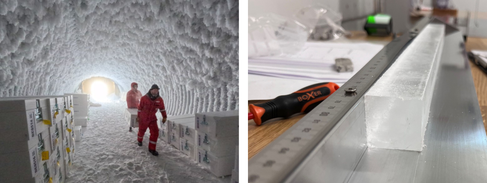
The Beyond EPICA ice cores. Left hand image shows the cores being moved into storage during fieldwork (Credit: Mulvaney©PNRA/IPEV) and, on right, one of the core sections in the lab.
Travelling time with ice
In June 2004, the EPICA (European Project for Ice Coring in Antarctica) community members published a paper in Nature, covering ground-breaking results of eight past glacial cycles going back to 800 thousand years ago, measured in high resolution for the first time, from what became the longest ice-core record of climate history we have.
In June 2019, 15 years after EPICA, the Beyond EPICAcommunity announced the start of a historical project, building on the legacy of the EPICA ice core whilst hoping to make new scientific breakthroughs in climate science.
After three field seasons drilling Antarctic ice, the Beyond EPICA consortium completed drilling – collecting 2800 metres of ice in field campaigns that involved participants from across Europe.
The newly drilled ice core dates back in undisturbed layers to 1.2 millionyears ago (!) so we were excited to join the team in Copenhagen and start measurements of the ice. In full anticipation of what secrets this ice would reveal, Yu and I, with our supervisors Rachael Rhodes and Thomas Bauska, and Lison Soussaintjean (a postdoc in our lab who’s done a whole PhD developing methods precisely for the measurement of this ice!) packed up our instruments and went to Copenhagen; to Physics of Ice, Climate, and Earth (PICE) at the Niels Bohr Institute in the University of Copenhagen to participate in this climate science adventure.
What followed were six weeks of wonderful international scientific collaboration in one room, all with the same goal: to learn as much as we possibly can from this ice core!
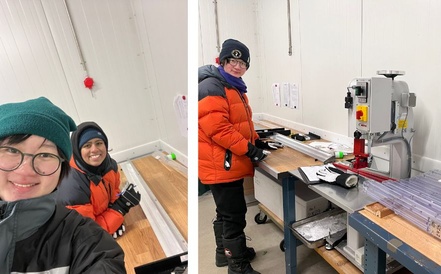
Janani and Yu, wearing thick orange puffer jackets and gloves, preparing the ice sticks for melting, using a band saw in -20 degrees freezer.
Analyzing the ice
We participated in a ‘Continuous Flow Analysis’ (CFA) campaign, a set-up that is highly sample efficient, enabling us to measure multiple parameters from a single stick of ice.
To describe the process very simply, we melt the stick of ice top to bottom on a heated metal plate (the “melthead”). On heating, the air that has been trapped in the ice is released and we pump out the innermost, cleanest portion of this melt-stream of gas and water. Water and gas are then separated from each other across a special membrane. The air is dried and sent to instruments for measurements of methane, nitrous oxide, carbon monoxide, carbon dioxide, isotopes of oxygen and nitrogen, as well as the total volume of air released.
Our campaign successfully ran three laser spectrometers (including a University of Cambridge LASER-ENVI instrument) and two mass spectrometers in series for the first time, all analysing a gas flow of just 1 millilitre per minute. Measurements of particulate dust and conductivity levels were also made on the water stream to help align our records with other measurements. All the water was collected in bottles and vials for offline measurements, including cosmogenic isotopes that are very useful for dating the ice core. The ancient air was also collected after analysis. Nothing is wasted!
Now, after a long, yet rewarding campaign, the instruments are packed up and the data are being analysed. The Beyond EPICA project will soon reveal how greenhouse gas levels (and their contribution to radiative forcing) in glacial and interglacial periods changed over the MPT, adding a major piece to the MPT puzzle. And we can tell you from our time in Copenhagen, that there are more exciting results watch out for!
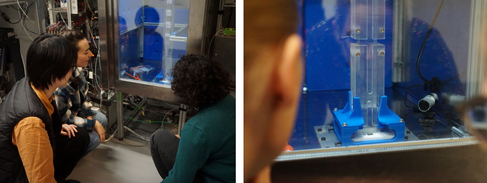
Lison, Yu, and Janani observing a section of ancient Antarctic ice being slowly melted in the freezer to release air that has been trapped for over a million years.
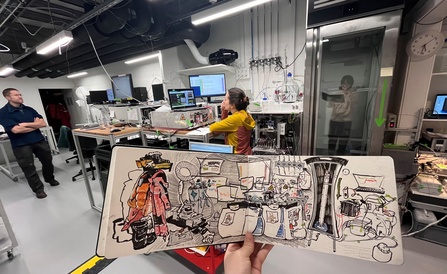
Yu’s hand-drawn sketch of the “gas side” held up against the real laboratory setup: a network of tubing, pumps, laser spectroscopy instruments and mass spectrometers, as well as the group’s freezer kit.