

Scientists from the University of Cambridge have studied how the bird skull evolved, helping to piece together how differences in development caused the varied appearances of modern birds.
Lead author of the study, Dr Olivia Plateau from Cambridge Earth Sciences, said, “birds are the only surviving lineage of dinosaurs, so understanding how developmental variation leads to changes in skull anatomy can provide insight into the dinosaur-bird transition.”
The researchers digitally scanned specimens from dozens of living bird species to investigate variation in skull structure, focusing on the palate bones, which form the roof of the mouth. Being so central to skull mechanics, the palate provides important clues about bird evolution.
With more than 11,000 living species, birds are one of the most diverse groups of vertebrate animals on Earth, varying widely in size, colour, and shape, and occupying nearly every corner of the planet.
Ostriches and other flightless ground birds, such as emus and kiwis have long been thought to have inherited the form of their palate bones from their dinosaurian ancestors, and as such are collectively known as palaeognaths (meaning ‘old-jaw’). Their skull, palate and jaw anatomy is very different from that of nearly all other birds, classed as neognaths (which means ‘new-jaw’).
For decades, scientists had thought that palaeognaths’ primitive, rigid palate might be a holdover from the dinosaurs, but more recent fossil finds suggest it may in fact be a later specialization.
So how did birds come to have such wide-ranging palate shapes? Some studies have suggested that the pace at which a bird develops after hatching can result in variation in adult anatomy. Shifts in growth rates and patterns over time are known to influence evolutionary trajectories, but their role in influencing the bones of the bird palate had never previously been investigated.
Developmental maturity key
The new study examined palate changes after hatching in bird species representing all major living groups. Olivia and colleagues from the Field Palaeontology Lab then compared the observed palate changes between palaeognaths and neognaths.
Their investigations showed that the degree of developmental maturity at hatching is the key factor in dictating how the bones of the palate grow and change as a chick matures.
Some birds are ‘precocial’, meaning their chicks hatch relatively mature, able to walk and move independently soon after emerging from the egg, like ostriches. Others are altricial, with chicks that hatch vulnerable and remain in the nest for extended periods, relying on their parents for food and protection, as seen in many small songbirds.
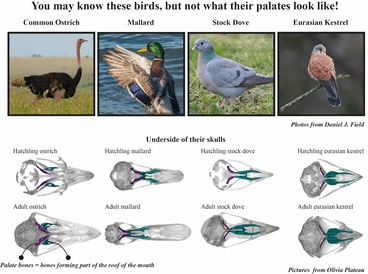
“How dependent or independent chicks are at hatching has a strong influence on how their skulls can evolve,” said Olivia. “These factors play a major role in determining how evolutionarily malleable the bones of the skull are.”
The findings highlight the important role of developmental variation in determining what kinds of new body plans evolution can produce. “The sheer variety of form exhibited by living birds is extraordinary and understanding how this variety has evolved can provide general insights into evolutionary biology that are applicable to any group of organisms.”
This work was undertaken while Dr Plateau was a joint postdoctoral fellow in the Field Palaeobiology Research Group in Cambridge and the Natural History Museum, Bern; the rest of the team was composed of Dr Juan Benito, Dr Guillermo Navalón, and Prof. Daniel J. Field, all of the Field Palaeobiology Research Group in the Department of Earth Sciences at Cambridge.
Reference: Plateau, O., Navalón, G., Benito, J., & Field, D. J. (2026). Developmental underpinnings of morphological disparity in the avian bony palate. Nature Communications.
Feature image credit Daniel Field.