

In this blog, PhD student Peter Methley describes the role of the oceans in cycling carbon through Earth’s history, and explains his lab experiments to recreate Precambrian seawater and crystallize ancient carbonate minerals in the lab.
What makes fizzy drinks fizz? Carbonated drinks, like lemonade, contain dissolved carbon dioxide that bubbles out when you open the bottle and pressure drops. You might not know that the world’s oceans are also full of dissolved carbon dioxide: in fact, they’re the largest carbon reservoir on Earth’s surface, containing forty times the amount currently stored in Earth’s atmosphere.
Roughly two-fifths of the CO₂ we emit into the atmosphere ends up dissolving in the oceans, entering a vast store of carbon where it may remain for thousands of years. Carbon dioxide is also gradually drawn down during the weathering of rocks and added to the oceans through rivers. This process has a cooling effect on our planet, although over timescales that are too slow to offset anthropogenic carbon emissions.
The oceans, aside from dominating Earth’s carbon cycle and balancing its long-term climate, are central for life, including as a source of carbon for photosynthesis and for the calcium carbonate (CaCO₃) shells that many marine organisms make to protect themselves.
These shells fall to the ocean floor, forming carbonate sediments and eventually rocks, which lock up carbon in Earth’s crust for millions of years. These rocks also record clues about Earth’s ancient oceans, marine life, carbon cycle and climate at the time they formed; signals that are of great interest to scientists like me.
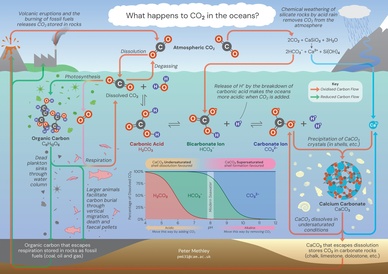
The flow of CO₂ into the oceans triggers a series of biogeochemical reactions that fundamentally alter ocean pH, and in turn its carbon chemistry. When more CO₂ is added, carbonic acid forms, increasing acidity and simultaneously decreasing the supply of carbonate ions that marine organisms need to build their shells. Image credit: Peter Methley.
Precambrian carbonates
For my PhD, I have been studying Precambrian rocks—the youngest of these having formed around 800 million years ago—to try and understand how ancient carbonate minerals formed. Because animals capable of producing calcium carbonate shells did not evolve until the end of the Ediacaran period, about 550 million years ago, Precambrian carbonate minerals must have formed either through non-biological processes or the indirect influence of life.
For instance, microbes can create conditions that help carbonate minerals form in seawater— either by changing the water’s chemistry or by releasing substances that encourage crystals to grow. Over time, this process may produce a layered microbial deposit known as a stromatolite: these structures are hallmarks of the Precambrian rock record and represent some of the earliest evidence for life on Earth. In August 2023, I was lucky enough to study 1.9-billion-year-old stromatolites, pictured below, during some remote fieldwork in Canada’s Northwest Territories.
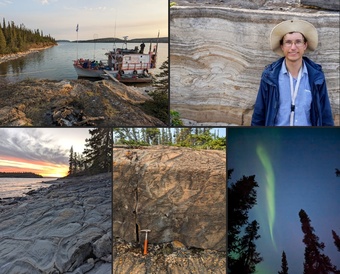
Photographs from my 2023 field campaign on the Great Slave Lake, Canada. The layered deposits seen in the lower left and centre images are stromatolites. Photo credits: Peter Methley.
Without biomineralising organisms removing carbon from the oceans to make their shells, the chemistry of the Precambrian oceans would have been significantly different to the present day. We expect that the seawater would have contained more dissolved carbonate than it does today, meaning that the seawater was highly supersaturated with respect to carbonate minerals. This different chemistry could explain why Precambrian carbonate rocks contain minerals and crystal textures that are currently poorly understood (something I’m trying to rectify in my PhD).
For instance, a substantial portion of Precambrian carbonate sediments do not consist of calcite (CaCO₃), but rather the mineral dolomite, CaMg(CO₃)₂, which is only rarely found in younger sediments, requiring high temperatures—typically only present deep underground—to form.
During my fieldwork in Canada, we found dolomite grains that had been eroded and re‑deposited in shallow water. We also observed dolomite mixed closely with calcite, which suggests the rock was not later altered into dolomite during deep burial. I also studied samples from the 800-million-year-old Draken Formation in Svalbard, which showed even more indicators of early dolomite formation. Something was clearly different about the Precambrian oceans to allow this amount of dolomite to precipitate from them.
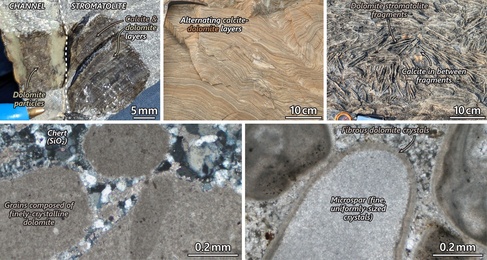
Evidence for dolomite having formed at the surface, in the Pethei Group (field photos in the top row) and Draken Formation (thin-section photos in the bottom row). Photo credits: Peter Methley.
Making minerals in the lab
The major hypothesis behind my PhD was that some of these mysterious minerals and rock fabrics could have formed in an unusual way, through ‘non-classical crystallisation’.
Minerals such as dolomite cannot directly crystallise from seawater because a large energy barrier inhibits its formation. However, if the seawater was extremely rich in dissolved minerals—as we think the Precambrian oceans were—something different could happen. Instead of forming dolomite crystals straight away, the water might first produce a glassy material called amorphous calcium‑magnesium carbonate. This contains all the right chemical ingredients to eventually become dolomite, and it can form much more easily because it doesn’t face the same energy barrier.
So, if amorphous carbonates formed in the ancient oceans, they could have been the first step toward making dolomite, or they could have settled as sediment and later turned into dolomite when buried underground.
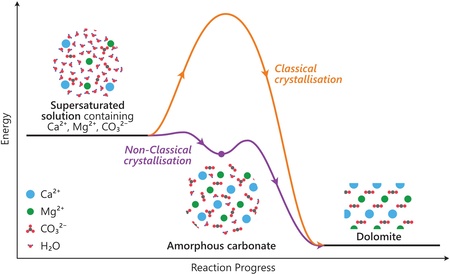
A non-classical crystallisation pathway via amorphous carbonate could enable dolomite to form with a much smaller energy barrier compared to the classical pathway. Note the irregular arrangement of ions in amorphous carbonate is more like the ions in solution than the regular crystal structure of ordered dolomite, hence the lower energy barrier. Image credit: Peter Methley.
The catch is that amorphous carbonates are unstable. They only form when the water is extremely supersaturated – far more than normal seawater. Under ordinary conditions, more stable minerals like calcite and aragonite would form first, using up the calcium and carbonate long before amorphous carbonates ever had a chance to appear.
We had a theory that, by adding impurities such as magnesium and phosphate to the seawater, we would be able to prevent calcite and aragonite growth, encouraging amorphous carbonate formation. In the lab, I dissolved various salts to create artificial Precambrian seawater, which I slowly evaporated to increase the degree of supersaturation. As this happened, I monitored the solution’s chemistry and analysed the minerals that precipitated using the Department’s scanning electron microscope, X-ray diffractometers and Raman microscope. When both magnesium and phosphate were present, the solution reached a much higher supersaturation, and a phase consistent with amorphous carbonate was identified in the solid products.
These experiments showed that the evaporation of seawater, in the presence of certain impurities, could allow amorphous carbonates to precipitate, kickstarting a non-classical crystallisation pathway that could eventually lead to dolomite. Leaving the amorphous carbonate in the solution for longer generated other metastable carbonate minerals, some of which formed spherical clusters of radiating crystals that could eventually have become calcite microspar: another puzzling rock texture that is abundant in the Precambrian.

Scanning electron microscope images of the products from my evaporation experiments, coloured based on the presence of different chemical elements. The first image shows aragonite, precipitated when magnesium but no phosphate was present; the second image shows amorphous carbonate, precipitated in the presence of magnesium and phosphate; the third image shows spheres of the mineral monohydrocalcite, produced by leaving the amorphous carbonate in the solution for a few more days; the fourth image shows hydrated magnesium carbonate, created when less calcium was added to the initial solution. Photo credits: Peter Methley.
We recently published these findings in Earth & Planetary Science Letters. It’s an important step in unravelling how these unusual crystals formed, but more research awaits: there’s still the small task of actually making dolomite from Precambrian seawater, and the Precambrian carbonate record contains many more unsolved mysteries…