

Not many science experiments require you to first take lessons in sugar‑making at your local bakery. But, for Quentin Kriaa, this was step one in learning how to make fluorescent pink sugar grains to recreate how iron crystals sink within planetary cores.
By sprinkling sugar into water tanks and watching the grains tumble, leaving swirling trails of dye as they dissolve, his experiments recreate ‘iron snow’; a phenomenon whereby iron crystals settle and melt inside the molten cores of small rocky worlds, such as Jupiter’s largest moon, Ganymede.
“Sugar is an ideal stand-in for iron crystals, dissolving much like iron melts to form a denser liquid,” said Quentin, a fluid dynamicist based at the Department of Earth Sciences and the Department of Applied Mathematics and Theoretical Physics. “It’s the swirling fluid motions triggered by those crystals that really interest me,” he explained.
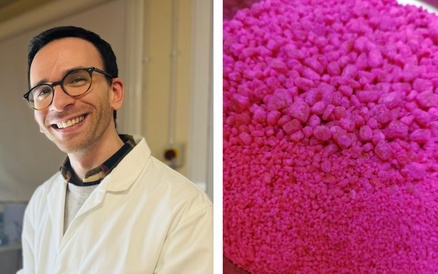
Quentin in the Fluid Dynamics Lab at the Bullard Labs and, on right, his pink sugar grains.
Unlike Earth’s core, which cools from the inside out, smaller planetary bodies such as Ganymede solidify from the edge of the core inward, forming a region of iron crystals near the edge of the core that ‘snow’ into the interior and melt at hotter depths.
As the iron melts, plumes of dense iron-rich liquid are released – stirring up the core and causing convection currents which may drive Ganymede’s present-day magnetic field. “Iron snow has been proposed by several researchers as a mechanism that may drive Ganymede’s dynamo,” said Quentin. “But we don’t know much about the physics behind this process.”
Scientists have used thermochemical computer models to show that fluid motion arising from iron snow can drive a magnetic field. But these models have a flaw, said Quentin. Without information on the iron crystals’ size, the models instead assume the crystals are so small that they behave like a dense liquid. “That’s a big assumption when we don’t actually know how particle size affects the flow,” said Quentin.
Particle size matters
To investigate, Quentin poured sugar grains into a tank of water, illuminated the tank with a laser, and filmed the particles as they dissolved. He repeated the experiment with different grain sizes to compare how the fluid motion changed.
First, Quentin tried supermarket coloured sugar, but found it unsuitable because the grains are only coated in dye, leaving faint and incomplete trails. So, Quentin decided to make his own dyed sugar. Following advice from his local bakery in Marseille, where Quentin was a PhD student at the time, he made his own by boiling caramel in the chemistry lab, mixing in dye, letting it set, then blending it in a food mixer. Over several days, he sieved the grains into different size fractions to create batches of different particle sizes for comparison.
His experiments revealed just how important particle size is for stimulating convection that is vigorous enough to generate a magnetic field. He found that large grains plummeted quickly and took a long time to generate any flow – an inefficient way to stir a planetary core. Small grains, however, dissolved quickly and produced vigorous currents, matching what the models assume.
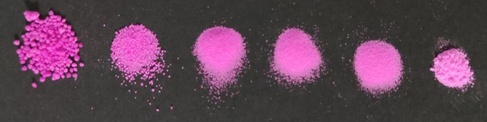
Sugar grains sorted by particle size ready for the tank experiments.
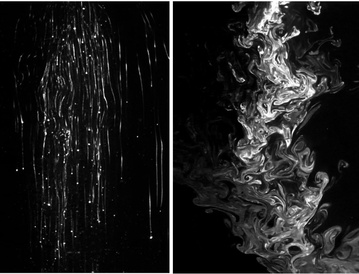
Stills of footage from the tank experiments showing: (left) dye trails left by large sugar grains, (right) swirling vortices created by small grains.
Much-needed observations
Now it’s a case of testing his results with observations from future space missions, said Quentin. He noted that more detailed mapping of Ganymede’s magnetic field might provide much-needed constraints on iron particle size. The smaller the iron crystals, the more turbulent the convection in the core and the more multipoles are likely to be observed in the magnetic field. “However, capturing detailed magnetic information, especially around small planetary bodies, is challenging, and the observed magnetic field depends on many other unknowns,” he added. “We’re not, at least yet, close to having an answer.”
Quentin recently reported the findings of his sugar experiments in the Journal of Fluid Mechanics.
Reference: Kriaa, Q., Favier, B., & Le Bars, M. (2025). Plumes of settling and dissolving sugar grains. Journal of Fluid Mechanics, 1022, A20.
Feature image: (left) Ganymede photographed by Juno in 2021. Credit: NASA/JPL-Caltech, (right) a still from one of Quentin's tank experiments to simulate how iron crystal size might influence Ganymede's internal convection.
#/media/File:Ganymede_-_Perijove_34_Composite.png)