

Tectonic activity is constantly reshaping Earth’s surface—ploughing continents together to build lofty mountains or pulling them apart so they may become basins or oceans.
Researchpresented at this year’s AGU Annual Meeting explores the rifting process in the Main Ethiopian Rift—part of a major fault system that is pulling East Africa in two to eventually form a new ocean.
The research, involving Cambridge Earth Sciences, used clues within crystals erupted from two volcanoes along the Main Ethiopian Rift to reconstruct the pace at which magma rose to the surface, revealing a rapid ascent rate more typical of mature rifts such as those in Iceland.
Magma plays a vital role in the breakup of continents, but scientists don’t fully understand how rising molten rock behaves within the crust as a rift gradually develops.
“Our work gives a new perspective on the processes that drive continental rifting,” said lead author of the research, Kevin Wong, who was formerly based at Cambridge Earth Sciences and is now at the Carnegie Institution for Science in Washington, DC.
Continental rifting involves two key stages: initially, the crust stretches via the breaking of large faults across a broad rifting region, as seen in Tanzania, one of the younger stretches of the East African Rift.
But tectonically mature rifts extend by large‑scale magmatic activity localised in the centre of the rifting region. Heat from the magma weakens the crust, accelerating the rift’s evolution toward complete rupture, as seen in the Afar region—the most northerly and well-developed segment of the East African Rift.
Wong and the team analysed olivine crystals contained within cindery volcanic ejecta erupted from two volcanoes in the Main Ethiopian Rift. They used these crystals as geochemical ‘stopwatches’ to trace the magma’s rapid journey through subsurface.
The crystals are made up of concentric layers of differing compositions that record changing conditions within the magma chamber as they grew. By examining variations in iron and magnesium across these layers, the researchers inferred the pathway the magma took to the surface.

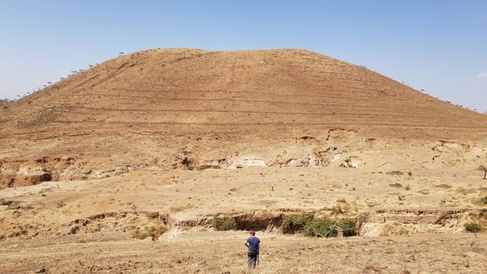
Kevin's field sites in Ethiopia, showing the typical rift landscape and scoria cone volcanoes he studied.
Rapid magma movement
Wong and team found that crystals from both volcanoes recorded magmatic changes occurring only weeks to months prior to eruption, indicating that the magma rose to the surface over this short time interval.
Rapid magma ascent was observed at both volcanoes, despite their being located roughly 100 kilometres apart, suggesting this behaviour may be characteristic of the Main Ethiopian Rift as a whole.
“The magma ascent mechanism we propose for the Main Ethiopian Rift closely resembles processes documented in mature rift zones—such as Iceland’s Reykjanes Peninsula,” said Wong. “This implies that, even though the Main Ethiopian Rift is only at an intermediate stage of tectonic development, its magmatic system can already transport magma swiftly through tens of kilometres of crust, much like the systems supplying more evolved rifts.”
He noted that the findings also provide information about the transition from fault-dominated rifting to the magma-dominated rifting. “Given that the volcanoes in the Main Ethiopian Rift are roughly 2 million years old, this change occurred geologically quickly—something that might be true of other rifts too.”
Wong and co-authors published their results earlier this year in Nature Geoscience, together with an accompanying blog post.
The research was conducted as part of the RiftVolc project and included researchers from the University of Leeds, Addis Ababa University, and the University of Cambridge.