

Back in the 1970s, renowned igneous petrologist Barry Dawson was sectioning a mantle rock from southern Africa when the cutting saw jammed on something extremely hard: a diamond.
It was the first time a diamond had been found in situ, locked inside a chunk of mantle rock carried up from hundreds of kilometres deep. Dawson, then at St Andrews, and his colleague Joseph Smith from the University of Chicago, went on to publish a 1975 Nature paper on the rock, showing that diamonds form much deeper in Earth’s interior than thought.
Exactly fifty years on and Professor Sally Gibson (Dawson’s former student) and her group in Cambridge have published new scientific results from the same rock sample, uncovering fresh clues about how Earth’s ancient interior cycled and stored volatiles. “This rock is still yielding important scientific information,” said Gibson.
Diamonds really are forever—or at least billions of years. Dawson’s diamond-bearing mantle rock dates from the Archaean, between 3.5 and 2.5 billion years ago, “rocks like this are time capsules that take us back to the early Earth,” said Gibson.
It was during the Archaean that the central cores of our major continents—including Africa, South America, North America, Eurasia, India and Australia—began to form. Over geological time, these cores (known as cratons) have acted as nuclei, growing to form the continents we see today.
Situated far from tectonic boundaries and composed of resilient material, these cratons have remained largely unchanged for 2.5 billion years, making their rocks among the oldest on Earth. With roots extending hundreds of kilometres into the convecting mantle, the only way to study their deep interiors is when volcanic eruptions bring up fragments of mantle rock known as xenoliths.
Dawson's collection, containing hundreds of mantle xenoliths from the Kaapvaal Craton, in Lesotho, during the 1960s, was central to Gibson's new study. “He amassed one of the world’s best collections of mantle material,” said Gibson. Dawson passed many of the samples onto Gibson for further study, “these rocks are a treasure trove of information and have yielded many student projects and papers. It’s almost as if I’ve inherited the family silver.”
Amongst that collection is the famous diamond-bearing sample that provided the first evidence that diamonds formed in the upper mantle, not in the magma that shuttled them to the surface as had been thought.
“I’ve still got the original thin section Barry gave me. He was so excited by the discovery—he wrote ‘diamond in it!’ on the label,” said Gibson.
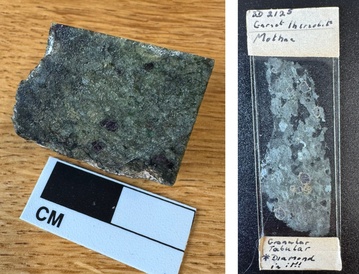
Dawson's famous diamond-studded mantle xenolith. Note his original annotations on the thin section.
“That same sample was central to our new study,” said Gibson. She and her former PhD students, Charlotte Jackson and James Crosby, together with researcher Jason Day, performed a new set of analyses on the Kaapvaal mantle xenoliths. “We were interested in their volatile content, and what that could tell us about the processes that built our planet.”
They found high levels of water, carbon, fluorine, and chlorine in the rocks. Gibson thinks these volatiles came from fluids driven off ancient oceanic plates that were subducted beneath the craton. As the ocean slab descended, fluids were released and percolated up through the craton.
This process happens in modern-day subduction zones, but the new study shows that subduction was already cycling water and carbon deep into the Earth during the Archaean. “The big question we’re trying to answer is how these deep-Earth volatiles, such as hydrogen and carbon, are stored within the planet’s interior and later transported to the surface through volcanic activity. This process plays a vital role in shaping Earth’s carbon cycle, regulating water availability, and influencing atmospheric composition—all of which are fundamental to sustaining a habitable planet,” said Gibson.
Out of the suite of mantle samples Gibson and team studied, the precious diamond-bearing sample yielded the most exciting results—containing the highest levels of volatiles, including carbon. “It’s thanks to this volatile enrichment that the diamond probably formed in the first place,” Gibson said.
Dawson’s samples now form part of the Sedgwick Museum’s collections. “This study just goes to show that old, archived samples really can still tell new and scientifically exciting stories,” said Gibson.
Read more
Gibson, S. A., Jackson, C. J., Crosby, J. C., & Day, J. A. F. (2025). The role of COHF-Cl fluids in the making of Earth’s continental roots. Nature Communications, 16(1), 7842.
Dawson, J. B., & Smith, J. V. (1975). Occurrence of diamond in a mica–garnet Iherzolite xenolith from kimberlite. Nature, 254(5501), 580-581.