For alumni especially, James Jackson is one of the best-known and most energetic members of the Earth Sciences department, and so it comes as a surprise to find that he has reached the official retirement age for academics. Here, the even older Nigel Woodcock looks back on James’s teaching, research and administrative career, and finds out what his plans are for “retirement”.
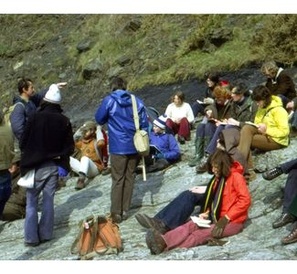
James's year group listen attentively as Bob Jull and Chris Hughes explain Carboniferous geology in Pembrokeshire in 1975. James is in the khaki anorak, next to the student in the yellow jacket.
James did his first degree in the old Department of Geology in 1973-6. These were the years just after plate tectonics had been formulated – in part up the road at Madingley Rise – but before the subject was deeply embedded in the Geology course. Nevertheless, it was geophysics that most interested James, such that he did a PhD at Bullard with Dan McKenzie on active tectonics in the Mediterranean. After a spell as a post-doc, James was appointed as a lecturer in 1984, in the then consolidated Earth Sciences department. He got promoted to Reader in 1996 and to Professor of Active Tectonics in 2002. This seemingly continuous career record in Cambridge masks the various short-term visiting positions that James held overseas: at M.I.T., Utah, Stanford and Caltech in the States; DSIR and IGNS in New Zealand; and CNRS Grenoble in France.
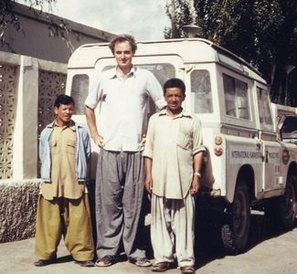
James with his cook and bodyguard on a research trip to the Karakorum in 1980.
James’s research is into how continents deform today. He has done field work throughout the Alpine-Himalayan Belt as well as in New Zealand, Africa and the USA, and has integrated field observations with those from space-based remote sensing and from seismology and geodesy. Many of his over 200 published research articles are widely cited and this research record has attracted prestigious honours: the Bigsby and Wollaston medals of the Geological Society, Fellowships of the Royal Society and of the American Geophysical Union, and the CBE.
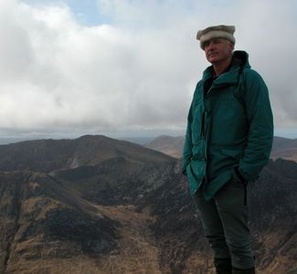
James on top of Goat Fell on a 2003 IA field trip to Arran.
However, alumni will know James as much for his teaching activity as for his research record. For many years he taught the opening lecture block in the first year Geology/Earth Sciences course. This was, and remains, a critical series of lectures for recruitment. Some incoming students are still unsure which subject to take as their fourth NST option, and James’s enthusiasm and ability to explain complex Earth processes outshone, to our advantage, lecturers in other subjects. These recruited students might well have met James again on the Arran field trip. If not they would get Part II/III Geophysics teaching from him in both in the lecture room and – more memorably still – on the Greek field trip.
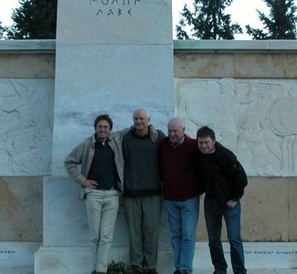
Professors White, Jackson, McCave and Maclennan at Leonidas's monument, Thermopylae on the 2010 Greek field trip.
Beyond Cambridge, James is a popular public science lecturer, most notably through his 1995 Royal Institution Christmas Lecture series on ‘Planet Earth an explorers guide'.
Although James would rather have been teaching or researching, he stepped up in 2008 to do an eight-year stint as Head of Earth Sciences, a job with steadily growing responsibilities and workload. Despite this administrative load, James still found time to supervise graduate students and, between 2012-18, to co-lead the `Earthquakes without frontiers' project: a partnership between UK earthquake scientists and those in countries of the earthquake belt between Italy and China. The aim was to share knowledge, expertise, training and resources to increase societal resilience to earthquakes.
Looking back at his career, James will emphasise the exhilaration of being part of a department that became a world leader by successfully combining research in geophysics, tectonics, petrology, geochemistry and basin analysis. He is particularly grateful for the vision of such as Ron Oxburgh and Dan McKenzie in unifying the three former components of the Earth Sciences department in 1980, and creating the collaborative research climate that has served the department so well.
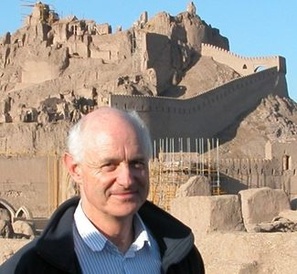
James in Bam, Iran after the December 2003 earthquake.
Looking forward to his career yet to come, he is particularly keen to continue his role in the application of earthquake science to mitigating the earthquake risk in Eurasian countries. His colleagues and former students look forward to seeing James fully involved in departmental life and in alumni events.