

A new study reveals why rocks within some mountain ranges get hot enough to form lithium-rich deposits—insights that could help pinpoint untapped sources of this critical mineral.
Dubbed the ‘white gold’ of the energy transition, lithium is essential for batteries that power electric vehicles and store renewable energy.
“We’re currently not producing enough lithium to meet rising demand,” said Alex Copley, lead author of the study from Cambridge’s Department of Earth Sciences. “Understanding how and where lithium forms could help target the search for new deposits.”
He and study co-author Owen Weller, also from Cambridge Earth Sciences, used model simulations to show that larger mountain ranges—particularly those with rocks containing radioactive minerals—are associated with the high temperatures needed to concentrate lithium.
The world’s lithium comes from two major sources: evaporation from brine lakes, and granitic rocks formed by mountain building. Whereas lithium in brines is well-studied, exactly how mountain building controls patterns of enrichment is less clear.
Mountain building happens when tectonic plates collide, deforming the Earth’s crust under immense pressure and heat. Some of the rocks melt, creating pockets of magma that eventually cool to form granitic bodies.
But not all granite intrusions are enriched in lithium. Whether they are is controlled by temperature: the hotter a mountain belt gets, the more lithium is concentrated in the magma that is produced.
Temperature is key
“We were interested in temperature as a crucial control on lithium enrichment,” said Copley. The new research repurposes a model developed previously by Copley’s research group to examine how earthquake occurrences relate to mountain belt temperature. A conversation with co-author Owen Weller led them to explore whether the same thermal model could also explain patterns of lithium enrichment. They thought temperature might be key because, “the most important host of lithium is likely to be in the mineral biotite, which melts at relatively high temperatures,” said Weller.
Using their model, they identified when and where temperatures became high enough to start melting biotite. Their model showed that this temperature threshold was exceeded when three conditions were met:
- Firstly, they found that thicker mountain ranges become hotter.
- How quickly the mountain belt formed also played a role in lithium formation. Although initially faster collision rates help build up the mountains, slower movements thereafter give rocks time to heat up, and for lithium-rich magmas to form.
- They also found that the presence of rocks containing naturally occurring radioactive elements such as uranium and thorium was essential in providing heat needed for melting.
Having confirmed that their model can reproduce known occurrences of lithium around the world, the researchers now say their approach could be used to locate new sources. “The idea is to use our work as a guide,” said Copley. “If you understand the characteristics of a mountain belt, you can start asking whether it hits the geological sweet spot for forming lithium deposits.”
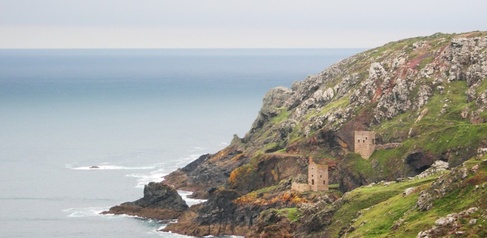
Cornwall has a long history of mining, its lithium ore deposits having formed during an ancient mountain building event. Copley's model can explain occurrences of lithium in Cornwall, highlighting its potential to pinpoint new sources.
Copley acknowledged that there are further factors involved in lithium enrichment beyond temperature, including the composition of the rocks that form the mountain belts, and later-stage processes that influence the magma chemistry, in particular whether minerals and melt can separate during cooling (known as fractionation). But he said that the findings were an exciting step in understanding the large-scale distribution of economically-important ores. “While much research has focused on individual deposits, there are still big, unanswered questions about what drives enrichment patterns across hundreds to thousands of kilometres. Using principles developed in the study of active tectonics helps us understand the broad, systematic trends.”
Copley now plans on applying similar methods to investigate the distributions of other critical minerals, including tin and tungsten, that also form due to melting in mountain belts.
Reference: Copley, A., & Weller, O. (2025). The tectonic, thermal, and temporal controls on the production of lithium‐enriched melts.Geophysical Research Letters, 52(21), https://doi.org/10.1029/2025GL118054
Feature image: An outcrop of 'white gold' lithium deposits. Credit: Owen Weller.