

New evidence reveals that unmelted asteroids originating from different parts of the Solar System were a key source of volatile elements during the formation of Earth and Mars.
Researchers from the University of Cambridge and Imperial College London measured zinc isotopes within Martian meteorites, tracing their unique signature to volatile-rich unmelted asteroids. As a volatile element, zinc can be used to identify the materials that likely supplied Mars with volatile elements—many of which are essential for life.
The study, published earlier this month in Scientific Reports, shows that asteroid type, not birthplace, was key to volatile delivery. Unlike Earth, which received material from the outer Solar System, Mars’ zinc came almost entirely from locally formed asteroids. Yet on both planets, the zinc was supplied mainly by primitive, unmelted asteroids.
The findings could help scientists understand how planets become habitable.“Whilst our finding doesn’t tell us whether there was life on Mars, we can say that its evolution is very similar to Earth in terms of its volatiles,” said Dr Rayssa Martins, lead author from Cambridge’s Department of Earth Sciences. “If you’re just looking at the volatile content, then Mars may once have been habitable too.”
Previously, Martins’ research has focused on Earth’s volatile inventory. In an earlier study, she found that material from beyond Jupiter supplied almost half of Earth’s zinc, with the rest coming from local, inner Solar System sources. “That’s striking,” she explained, “because the outer Solar System component is thought to make up less than ten percent of Earth’s total mass.”
In a subsequent study, Martins showed that the type of planetary building block, or planetesimal, mattered more. Around 90% of Earth’s zinc came from primitive, unmelted planetesimals. In contrast, although most of Earth’s mass was supplied by differentiated planetesimals (about 70%), they contributed only about 10% of its zinc. These bodies experienced intense melting and separated into core, mantle and crust, a process that drove off much of their volatile content.
“With our work so far based solely on Earth, it was unclear whether other volatile-rich planets would show a similar pattern,” said Martins.
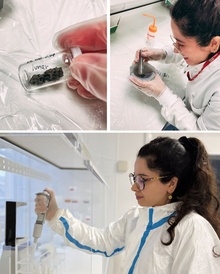
Rayssa Martins with some of her meteorite samples in the lab.
In the latest study, the researchers applied the same approach to Mars, measuring zinc isotopes in a suite of Martian meteorites to determine where the planet’s zinc came from.
This time, they found that Mars, unlike Earth, sourced almost all its zinc from local materials. But the key factor in volatile delivery, as in the case of Earth, was the incorporation of primitive, unmelted planetesimals, which made up around half of Mars’ mass but supplied about 90% of its zinc.
“This confirms that primitive materials are the key suppliers of volatiles,” said Martins. “Even though Mars and Earth sourced their zinc from different regions of the Solar System, the materials that supplied the zinc were essentially equivalent.”
Martins explained that these primitive planetesimals likely formed later in the Solar System’s evolution, possibly a few million years after the differentiated planetesimals.
“This delay meant that, by the time the planetesimals formed, radiation had died down, so there wasn’t enough energy to melt them and drive off their volatiles. That’s what allowed these planetesimals to preserve their volatile elements, making them major contributors to the volatile inventories of terrestrial planets,” said Martins.
To test whether this pattern held for other terrestrial bodies, Martins also analysed lunar samples to gain insights into Theia – the Mars-sized protoplanet that collided with Earth to form the Moon. However, the limited amount of lunar material available, combined with its very low zinc concentrations, made it difficult to make measurements precise enough to distinguish between the compositions of Earth and the Moon.
“Such data could provide valuable clues about Theia’s contribution to Earth’s volatiles, but reaching the necessary precision remains a major challenge,” said Martins.
Although more data is needed, Martins said her work throws light on how planetary building blocks decide the fate of life on a planet.
“It definitely looks like, in order to have a habitable planet, we do need to have primitive materials,” she said.
Martins will present her results at the ‘Impact of UK Planetary Geoscience’ meeting, hosted by the Geological Society and the Royal Astronomical Society, on Thursday 27th November.
Reference: Martins, R., Morton, E. M., Huang, Y., Williams, H. M., & Rehkämper, M. (2025). Provenance and distribution of zinc in terrestrial planets. Scientific Reports, 15(1), 40546.
Feature image: An iron meteorite from the core of a melted planetesimal (left) and a chondrite meteorite, derived from a ‘primitive’, unmelted planetesimal (right). Credit: Rayssa Martins/Ross Findlay