

Sara Crozier, third year PhD student and isotope geochemist reports on the 2025 Goldschmidt in Prague in this blog post.
The journey from Cambridge to Prague was short and relatively painless — a smooth hop across Europe, and before we knew it, we were off and running. The conference centre itself was easy to find, just one metro stop from the city centre and perched majestically atop a hill. Bright, open, and well-organised, it offered sweeping views and easy navigation, full credit to the organisers for making everything feel so accessible from the get-go.
Many of us reunited or met for the first time at the icebreaker event. Finding familiar faces among the 4,000+ attendees was no small task— especially while being distracted by an endless supply of free food and drinks— but eventually we found each other!
This year’s Cambridge cohort was an impressive bunch, presenting across an eclectic mix of topics — from mantle geochemistry and cosmochemistry to low-temperature weathering processes and even agricultural geoscience. My own research focuses on mantle processes and the chemical and isotopic signals they generate.
For several of us, this was our first major international conference—and what an introduction it was. We met researchers from all over the world, reconnected with colleagues from past projects, and made new friends in all corners of geoscience.
We hit the ground running the next morning, fuelled by conference-grade filter coffee and Czech pastries (which, by the way, did not disappoint). Cambridge was on the schedule bright and early, with Josh Shea kicking off the week at 8:30 am talking about carbon degassing in Icelandic magmas; a strong start.
The poster sessions were a highlight. The room was buzzing — quite literally. These evenings were where the real networking happened. Bright-eyed PhD students wandered through rows of posters, nervously approaching some of the biggest names in the field. They say you should never meet your heroes, but clearly they’ve never met geologists, what an overwhelmingly kind and generous bunch of people.
Even after 11 hours of talks and sessions, our brains full to the brim with data, discussions, and acronyms, the days didn’t stop there. The first major social event of the week was a boat party along the Vltava River full of drinks, dancing, city views, and, unexpectedly, some delightfully friendly river rodents called nutria. They’re basically giant, adorable water guinea pigs: what’s not to love?
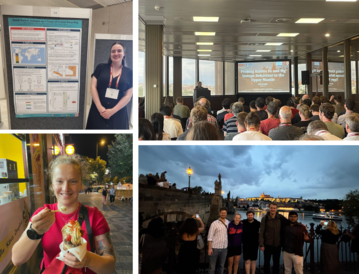
Jane Macdonald and Sara (top left and right respectively) presenting their research. Below left and right: enjoying the local food and sights.
Having given my talk on the first day, I felt free to fully embrace the rest of the week. The pattern continued: early mornings, long days, but so much fun. Midweek brought the Thermo Fisher party, always a hot ticket, and many of us were lucky enough to attend. Some were beginning to fade by then, but the energy of the crowd carried us through.
Outside the conference, there was just enough time to explore Prague. We wandered through the old castle walls, soaked in the city’s history, and sampled plenty of local food like rich stews and warm pastries (Prague is not the place to go if one is a vegan though!). I even tried absinthe for the first time, once was enough…
Though I stayed in the city and didn’t get a chance to see any of the local geology myself, I’ve heard it’s spectacular (particularly the Bohemian Massif exposures just a short drive away). Definitely something to return for.
Overall, Goldschmidt 2025 was an incredibly rewarding and enjoyable experience — academically stimulating, socially vibrant, and full of memorable moments. It was a huge milestone for many of us, and an inspiring reminder of why we do what we do. Massive thanks to the organisers for putting on such an exceptional event. I already can’t wait for the next one!