

PhD student Julian Pahl recounts his fieldwork in Hawaiʻi this summer, where he got a chance to sample historic lava flows and witness the ongoing eruption of Kīlauea.
Hi! I am Julian, a second-year PhD student specialising in igneous petrology at Cambridge’s Department of Earth Sciences. My research focuses on the magmatic processes of active volcanoes, particularly ocean-island volcanoes. For my PhD, I am studying past eruptions of the Southwest Rift Zone of Mauna Loa on the Island of Hawaiʻi.
During the summer, I had the opportunity to travel to the Island of Hawaiʻi for fieldwork. The trip was an important opportunity for me to collect samples from three historic eruptions (1868, 1887, 1907) and obtain important spatial observations of the lava flows.
Additionally, I connected with my co-supervisor and other researchers from the Hawaiian Volcano Observatory to discuss our collaboration, explore potential future projects, and learn about the observatory's operations. The connection to the Hawaiian Volcano Observatory is invaluable and highly beneficial, as it provides crucial context for my fieldwork area.
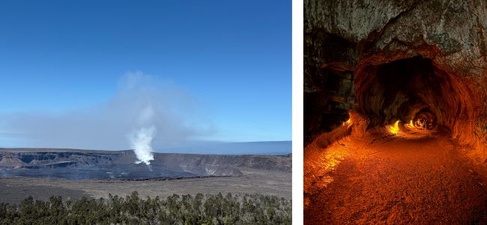
Degassing at Kīlauea's active vent (left) and the Nāhuku Lava Tube (right). Credit: Julian Pahl.
One of the many highlights was my accommodation on the Island of Hawaiʻi. I stayed in a bungalow within Hawaiʻi Volcanoes National Park, just a five-minute walk from the rim of Kīlauea's caldera. Thanks to minimal light pollution, I was able to enjoy stargazing on clear nights and observe the Milky Way. Impressive!
Our main field site is situated on the southern side of the Island of Hawaiʻi, about a one-hour drive from the accommodation. Fortunately, the drive followed the scenic Highway 11 along the slopes of Mauna Loa and later the coast. Myself and the field team stopped in Naalehu to visit southernmost bakery in the USA and try their famous Malasadas for breakfast. Fuelled by the Malasadas, we arrived at the Kahuku Unit (field site) to put on our hiking boots and prepare for fieldwork.
We started field investigations at the 1868 lava flow of Mauna Loa, the project's focus, and luckily, we could reach the distal parts of the lava flow by car. After a brief hike across the lava flow, we collected our first tephra and lava samples near a collapsed vent. As we hiked down the lava flow along a fissure and spatter ramparts (raised ridges that form around a volcanic vent), we collected samples from several locations.
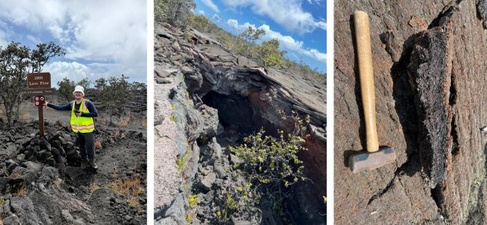
Sampling the 1868 lava flow of Mauna Loa.
The 1868 lava flow of Mauna Loa is riddled with lava tubes and is also a striking because of high contents of olivine crystals. We sampled the flow down to the visitor centre of the Kahuku unit, then returned to the car to gather samples from the 1887 and 1907 lava flows on roadcuts along the highway.
The following day, we focused on collecting samples from the 1907 lava flow, which proved more challenging to access. We took our four-wheel drive on an off-road adventure to explore the southern part of the lava flow near the coast.
The fieldwork ended where it had begun, at the 1868 flow, sampling the highest section of the lava flow, followed by a scenic one-hour drive back to the main site of the National Park.
After a successful field campaign, having collected samples and contextual information about the 1868, 1887, and 1907 lava flows, my trip was made even more exciting by witnessing the current volcanic activity at Kīlauea!
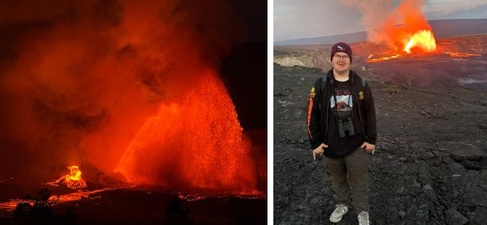
Witnessing episode 33 of Kīlauea’s current eruption.
This, the most memorable part of the trip, was saved for the final days. Still quite jet lagged, I woke up in the middle of the night for several consecutive nights. I managed to observe some gas-pistoning events (gas trapped beneath a viscous lava surface causes the lava to rise and fall rhythmically) at Kīlauea and watched lava flowing from the active vents.
However, the true highlight came a night later. I woke up early again (completely worth it) and was incredibly lucky to witness episode 33 of the ongoing Kīlauea eruption. This episode featured lava fountains reaching heights of hundreds of metres, ejecting a tremendous amount of lava and covering parts of the crater floor.
It was an extraordinary event, with tephra tornadoes that left me speechless. I was fortunate to observe the eruption and all its remarkable features from its early stages at night through to the morning, just before it ended later that day. The highlight of my trip and my relatively early career as a volcanologist!
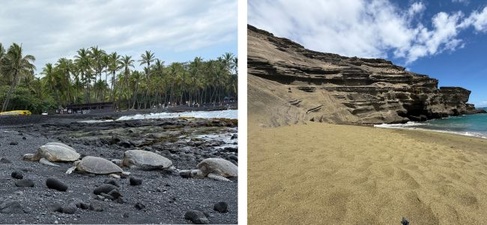
The sand beaches of the Island of Hawaiʻi were among the most impressive beaches I have seen. Left: Punaluʻu Beach, with the black sand and the protected Hawaiian green sea turtle, right: Papakōlea Beach, a green sand beach made of olivines.
Ultimately, I would like to extend my gratitude to Kendra, Dawnika, Heather, and Christina from the Hawaiian Volcano Observatory for their help with the fieldwork. Your ongoing advice and support are greatly appreciated! The fieldwork was carried out under a research permit from the National Park Service (HAVO-2025-SCI-0007).