
A special issue of ‘The Depositional Record’, a journal of the International Association of Sedimentologists, celebrates the work of Cambridge Earth Sciences’ Dr Tony Dickson.
Tony Dickson, who joined the Department of Earth Sciences in 1981, is known not only for his legacy of innovative research on carbonate diagenesis, but also for his contributions as a mentor and teacher over more than 50 years. He taught carbonate sedimentology to generations of Cambridge students. He also ran the Dorset field trip; the evening seminars that he introduced becoming standard practice on all Department field courses. Even more memorable were his field courses to West Texas, New Mexico and the Bahamas.
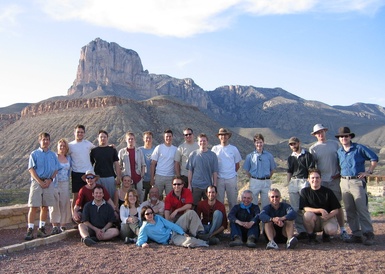
Group photo, 2004. In front of the world famous Permian Reef, Guadalupe Mountains on the Texas/New Mexico border. Present are leaders Art Saller and Tony Dickson, assisted by Nigel Woodcock.
The special issue, which was authored by colleagues and a former PhD student, explores how Tony’s pioneering work transformed our understanding of carbonate rocks and in turn paved the way for modern analysis of carbonates.
One of his early breakthroughs, described in Nature in 1965, was the development of a staining technique to distinguish calcite, dolomite and their iron-rich variants in thin sections. Tony originally developed this method as part of his PhD and it is still used today, including by our Part II mapping students.
By the 1980s, Tony was exploring carbonate crystal growth and zonation using early geochemical techniques, including cathodoluminescence, stable isotope and trace element analysis.
Employing state-of-the-art analysis has been a common theme of his career. In fact, in this special issue Tony, together with Peter Swart, re-examine one of his published datasets with a new technique and disprove their earlier publication. Tony also has a YouTube channel where he continues to publicize his latest research.
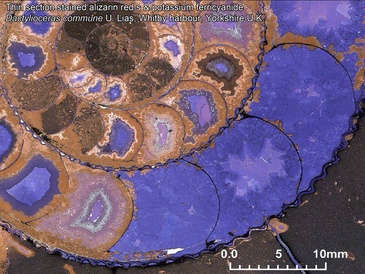
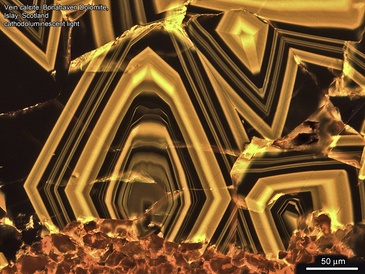
Thin section cathodoluminescence image, zoned calcite cement growing centripetally into a small vein, Bonahaven Dolomite, Dalradian, Islay, Scotland. Below: Stained thin section showing variation in the fill of an ammonite’s camerae; brown - lime mud ,red - non-ferroan calcite, and mauve, purple and blue ferroan calcite with varying amounts of ferrous iron present. Both credit: Tony Dickson.