

Amongst the fjords in the Faroe Islands lies a peculiar type of farm. From above, it looks like lines and lines of rope suspended in the water, but hidden beneath the surface is an underwater forest of kelp.
Cambridge researcher Zhenna Azimrayat-Andrews spent last summer there, trying to understand just how much this fast-growing seaweed could help fight climate change.
Like trees, kelp captures and stores carbon dioxide from the atmosphere. But it has a key advantage: speed.
“Imagine you’re trying to grow a rainforest, but the trees grow about a foot a day,” says Zhenna Azimrayat-Andrews, a PhD student working jointly between Cambridge’s Earth Sciences and Applied Mathematics & Theoretical Physics departments. “You could really store a lot of carbon quickly because of just how fast the biomass grows.”
Globally, kelp and other seaweeds are thought to sequesternearly 200 million tonnes of CO2every year. As kelp grows, it absorbs CO2through photosynthesis, locking carbon into its tissue. When it dies, much of that biomass sinks - sometimes thousands of metres - to the deep ocean, where cold temperatures and pressure slow decomposition to a crawl. Carbon stored there can remain out of the atmosphere for centuries, possibly longer. But climate change, poor water quality, and overfishing are threatening these underwater forests - with consequences not just for the climate, but for ecosystems, food supplies, and the communities that depend on them.
Zhenna's fieldwork took her to a farm nestled in a fjord called Gøta, in the north-east of the islands, run byOcean Rainforest- a company that grows, harvests, and processes seaweed for everything from food and animal feed to cosmetics. Her goal was to measure how quickly kelp regrows after harvesting, feeding real-world data back into the climate models being developed with the team atCambridge's Centre for Climate Repair.
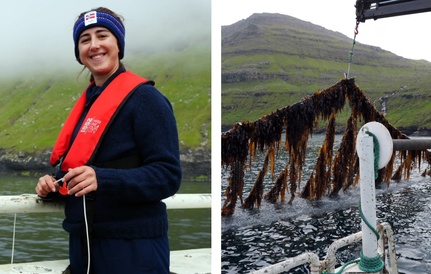
Left: Zhenna during fieldwork on the Faroe Islands. Right: Kelp being lifted by crane from the water. The farm harvests the fast-growing seaweed for a range of products. Both credit Rob Dunbar, Stanford University.
The setting was a little different to her usual office. "The Faroe Islands are beautiful. They're extremely rugged and stunning," she says. "It's very rare for there to be sun, but it's a very dramatic landscape." Heading out to the boat each morning felt, she admits, slightly unreal.
"Imagine going into a Lord of the Rings-type set just to do your work for the day. It was really, really cool."
Most days she worked alongside a team from Stanford, UC Santa Barbara, and UC San Diego studying the physical oceanography of the area, measuring conductivity, temperature, and depth. With such close collaboration, rather than competition, there is a wealth of data being collected from this farm and others. Once that work was done, they turned to her biomass project. "We would pull the kelp out of the water, hold it across the boat with a giant crane, and I would get all the physicists to measure a frond of kelp for me," she says. "That was really fun."
The data will help the team build more accurate models of how much carbon kelp farms and forests can actually remove. While we know the ocean has absorbed around a quarter of all human-caused carbon emissions, there are still major uncertainties about how that storage works, how long it lasts, and what happens when kelp forests are lost - or restored.
The trip wasn't without its frustrations. On the first day of their second visit, the boat generator broke down. An hour later, once that was fixed, the crane - essential for hauling tonnes of kelp out of the water - stopped working too. They returned to shore, called the technicians, and waited. When the captain tried to demonstrate the fault, the crane worked perfectly. "The technicians were just laughing at us," Zhenna recalls, "and we had our heads in our hands, thinking how we'd just lost two hours of sampling. But I'd rather it be that way round than for it not to work at all."
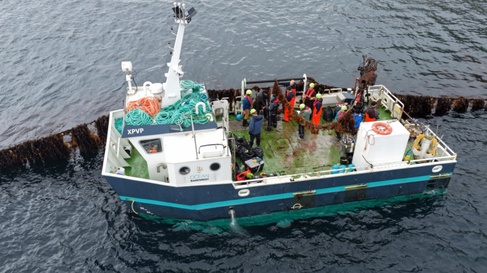
With researchers from multiple institutions and disciplines on board, they were together able to collect a "treasure trove" of data. Credit Rob Dunbar, Stanford University.
There were better days too. The team was invited to join Ocean Rainforest's annual Summer Day Out with a trip to an island that, Zhenna says, "is invitation-only for people who live there." It happened to be the only sunny day of her entire two-week stay. "We went hiking, we ate kelp from the farm for lunch, and I got to spend time with the farmers and my collaboration group, who I don't get to see very often. It was just a really lovely day."
One of the quieter highlights of the trip was mentoring a Master's student on her first fieldwork experience. "It was really fun to literally and theoretically pass on the baton of fieldwork," says Zhenna. "To be able to say, 'This is how it works' - I was really happy I could give her that experience.
Zhenna hopes to be able to return this summer for more sampling and to develop the models even further, as there is much more to learn about how kelp might be utilised in future as a carbon sink. "We're not there yet. But I feel very lucky to be working with a team that is starting to investigate this now."
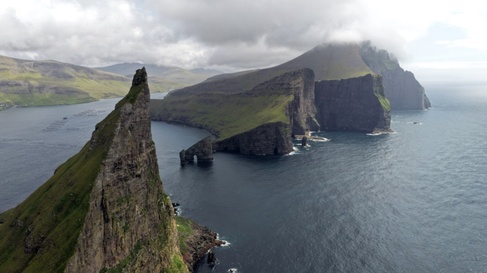
A view across nearby Tindhólmur. Credit Rob Dunbar, Stanford University.
Words by Emma Noble, Centre for Climate Repair, and republished with permission. The original story can be found here.
Feature image: Kelp farm viewed from above. Credit Rob Dunbar, Stanford University.